
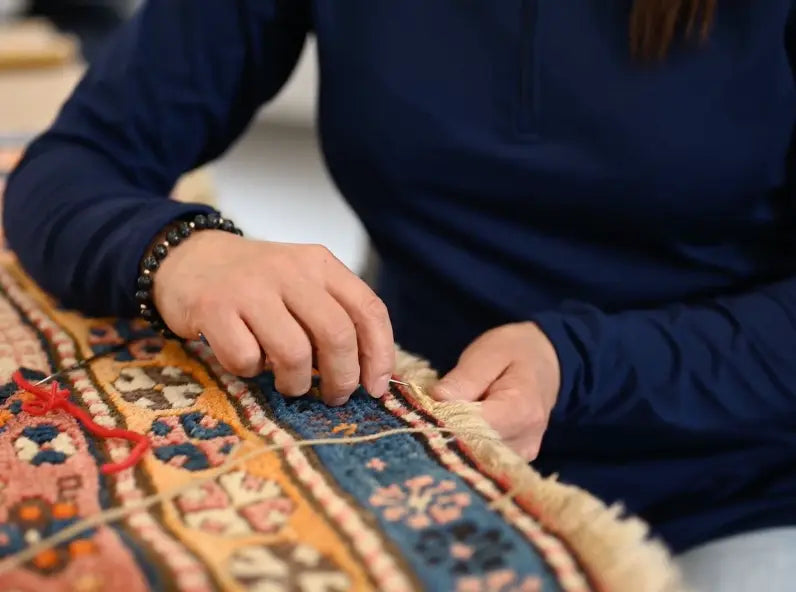
A hand-knotted rug carries a level of craftsmanship you can usually see, feel, and trace through the way it was made. Every knot is tied by hand onto the rug’s foundation, which gives the piece its structure, pattern, durability, and character.
The challenge is that many rugs are marketed with similar language. “Handmade,” “handcrafted,” “hand-tufted,” and “hand-knotted” do not mean the same thing.
In this article, we’ll walk through the clearest signs that can help you tell if a rug is hand-knotted before you buy, clean, sell, or appraise it.
Key Takeaways
- A hand-knotted rug is made by tying individual knots onto the rug’s foundation, not by printing or gluing a design onto the backing.
- The back of the rug is one of the best places to check because the pattern should usually be visible from the underside.
- Authentic fringe is typically part of the rug’s foundation, while sewn-on or glued-on fringe can point to machine-made construction.
- Small variations in the pattern, border, or edges can be a sign of hand craftsmanship.
- Hand-knotted rugs usually feel flexible and woven, not stiff, rubbery, or layered with adhesive backing.
- Hand-tufted rugs are not the same as hand-knotted rugs, even though both may be described as “handmade.”
- Price can offer a clue, but it does not prove authenticity. Construction, materials, condition, and expert inspection matter more.
- For the clearest answer, have the rug inspected by a trusted rug specialist before buying, cleaning, selling, or insuring it. Isberian Rugs can help identify the construction, condition, and proper care needs of hand-knotted rugs.
What Does “Hand Knotted” Actually Mean?
A hand-knotted rug is made by tying individual knots onto vertical foundation threads called warps. The weaver builds the rug row by row, knot by knot, until the full pattern appears. This is slow, skilled work. Depending on the size, design, materials, and knot density, one rug can take months or even years to complete.
That process is part of what makes hand-knotted rugs so valuable. They are not printed designs or quick decorative coverings. The pattern is physically built into the rug. The front, back, fringe, edges, and texture all carry clues about how the rug was made.
Hand-knotted rugs are often made from wool, silk, cotton, or a combination of natural fibers. Many Oriental, Persian, Turkish, Indian, Chinese, and tribal rugs fall into this category, though origin alone does not prove construction. You still need to inspect the rug closely.
Here’s how you can do that effectively:
Start With the Back of the Rug
The back of the rug tells you a lot. In many cases, it tells you more than the front.
Turn the rug over and look at the design. On a true hand-knotted rug, the pattern should be visible from the back. It may look softer or less vivid than the front, but you should still be able to follow the main shapes, colors, and borders.
You should also see the knots. They may look slightly uneven because they were tied by hand. This does not mean the rug is poorly made. In fact, small variations are often a sign of human craftsmanship.
A machine-made rug usually looks much more uniform. The back may have a perfect grid, a mesh-like appearance, or a backing that hides the construction. If the back looks too flat, too perfect, or covered by fabric, that is a sign to look more carefully.
Check the Fringe
Fringe is another useful clue.
On a hand-knotted rug, the fringe is usually part of the rug’s foundation. It is not added later for decoration. The fringe comes from the warp threads that run through the length of the rug. In other words, it is part of the structure.
Look closely at where the fringe meets the body of the rug.
- Does it seem to continue naturally from the rug itself?
- Does it look sewn on?
Sewn-on, glued-on, or stitched fringe can be a warning sign. Many machine-made rugs use attached fringe to imitate the look of a hand-knotted piece. That does not always mean the rug is low quality, but it does mean it is not constructed the same way as a true hand-knotted rug.
Look for Small Irregularities in the Pattern
Handmade rugs often have small variations. The border may not be perfectly straight. A floral motif may look slightly different from one side to the other. A color shift may appear in the field. The spacing may change in small ways across the rug.
These details often show that a real person made the rug by hand.
Machine-made rugs tend to repeat patterns with exact precision. Every motif looks identical. The border sits with strict uniformity. The spacing stays almost perfectly even from end to end.
That level of perfection can be attractive, but it often points to machine production.
Feel the Texture and Flexibility
The way a rug moves can also help you identify its construction.
Hand-knotted rugs often feel flexible and supple. You can bend them, fold a corner gently, or move them without feeling a hard, rubbery backing. The rug may feel dense, but it should not feel like the pile is glued to a stiff base.
Hand-tufted rugs often feel heavier and stiffer because the yarn is punched into a fabric backing and secured with adhesive. Many have a cloth covering on the back. Over time, that latex backing can dry out, crack, or release a powdery residue.
A simple test: lift one corner and gently bend it. A hand-knotted rug usually moves as one woven structure. A rug with glued backing may feel more rigid or layered.
Inspect the Materials
Many hand-knotted rugs are made with natural fibers. Wool is one of the most common materials because it is durable, resilient, and well-suited for detailed weaving. Cotton is often used for the foundation. Silk may appear in finer rugs, either on its own or blended with wool.
Material can give you clues, but it does not prove everything.
A wool rug is not automatically hand-knotted. A synthetic rug is not automatically machine-made in every case, though synthetic fibers are more common in mass-produced rugs. You need to look at the construction and the material together.
Run your hand across the pile. Wool often feels warm, springy, and substantial. Silk feels smoother and may have a natural sheen that changes with the light. Synthetic fibers can feel slicker, shinier, or more plastic-like.
You can also look at how the fibers sit in the rug. In a hand-knotted rug, the pile grows out of the knots tied into the foundation. In a printed or glued rug, the surface may feel more like a layer attached to something underneath.
Know the Difference Between Hand-Knotted, Hand-Tufted, and Machine-Made Rugs
Many buyers confuse these three categories, so it helps to know the difference.
Hand-knotted rugs are made by tying individual knots by hand onto a foundation. The design is part of the rug’s structure. You can usually see the pattern on the back. These rugs tend to be more durable, repairable, and valuable, especially when made with quality materials and skilled weaving.
Hand-tufted rugs are made by pushing yarn through a fabric backing with a tufting tool. The back is then secured with adhesive and often covered with cloth. They can look plush and attractive, but they are not hand-knotted. They usually do not have the same long-term value or lifespan.
Machine-made rugs are produced by machines. They often have very uniform patterns, synthetic fibers, and consistent backing. They can be affordable and practical, but they usually do not carry the same craftsmanship or collectible value as hand-knotted rugs.
Price Can Be a Clue, But Not Proof
Hand-knotted rugs usually cost more because they require time, skill, and quality materials. A large hand-knotted rug with fine wool, silk details, natural dyes, and a dense knot structure will not usually sell at the same price as a mass-produced rug.
Still, price alone does not prove authenticity.
Several factors affect value, including:
- Age
- Size
- Condition
- Origin
- Material
- Knot density
- Design complexity
- Color quality
- Repair history
If a seller calls a rug “hand-knotted,” ask to see the back, fringe, and edges. A trustworthy seller should have no problem explaining the rug’s construction.
When Should You Ask a Rug Expert?
Some rugs are easy to identify. Others need a trained eye.
You may want a rug expert to inspect the piece if you are buying an expensive rug, selling an inherited rug, planning to clean an antique rug, or trying to understand its value for insurance. Expert help also matters if the rug has repairs, heavy wear, replaced fringe, or an unclear origin.
A professional can look beyond the obvious signs. They can assess knot structure, materials, dye quality, age, condition, and regional weaving details. That kind of evaluation is especially useful for Oriental, Persian, tribal, antique, and collectible rugs.
It is also wise to get expert guidance before cleaning a rug you believe may be hand-knotted. The wrong cleaning method can damage natural fibers, loosen dyes, weaken fringe, or harm older foundation threads.
If you have a rug you want to identify, clean, repair, or preserve, Isberian Rugs can help you understand what you own before you make the next move. A careful inspection can protect the rug’s value and help you care for it the right way.
FAQs
How can I tell if my rug is hand-knotted?
Turn the rug over and look at the back. A hand-knotted rug usually shows the same pattern on the back, with visible knots and slight irregularities. You should also check if the fringe is part of the rug’s foundation, not sewn or glued on after production.
Should the back of a hand-knotted rug show the pattern?
Yes. In most hand-knotted rugs, the design should be visible from the back because the pattern is built into the rug through the knotting process. The back may look softer than the front, but the main design should still be readable.
What is the difference between hand-knotted and hand-tufted rugs?
A hand-knotted rug is made by tying individual knots onto a foundation. A hand-tufted rug is made by pushing yarn through a backing and securing it with adhesive. Hand-tufted rugs can look beautiful, but they do not have the same construction or long-term value as hand-knotted rugs.
Are hand-knotted rugs always valuable?
Not always. Many hand-knotted rugs have strong value, but the actual worth depends on age, origin, condition, size, material, craftsmanship, and demand. A damaged or poor-quality hand-knotted rug may be less valuable than a well-made piece in good condition.


